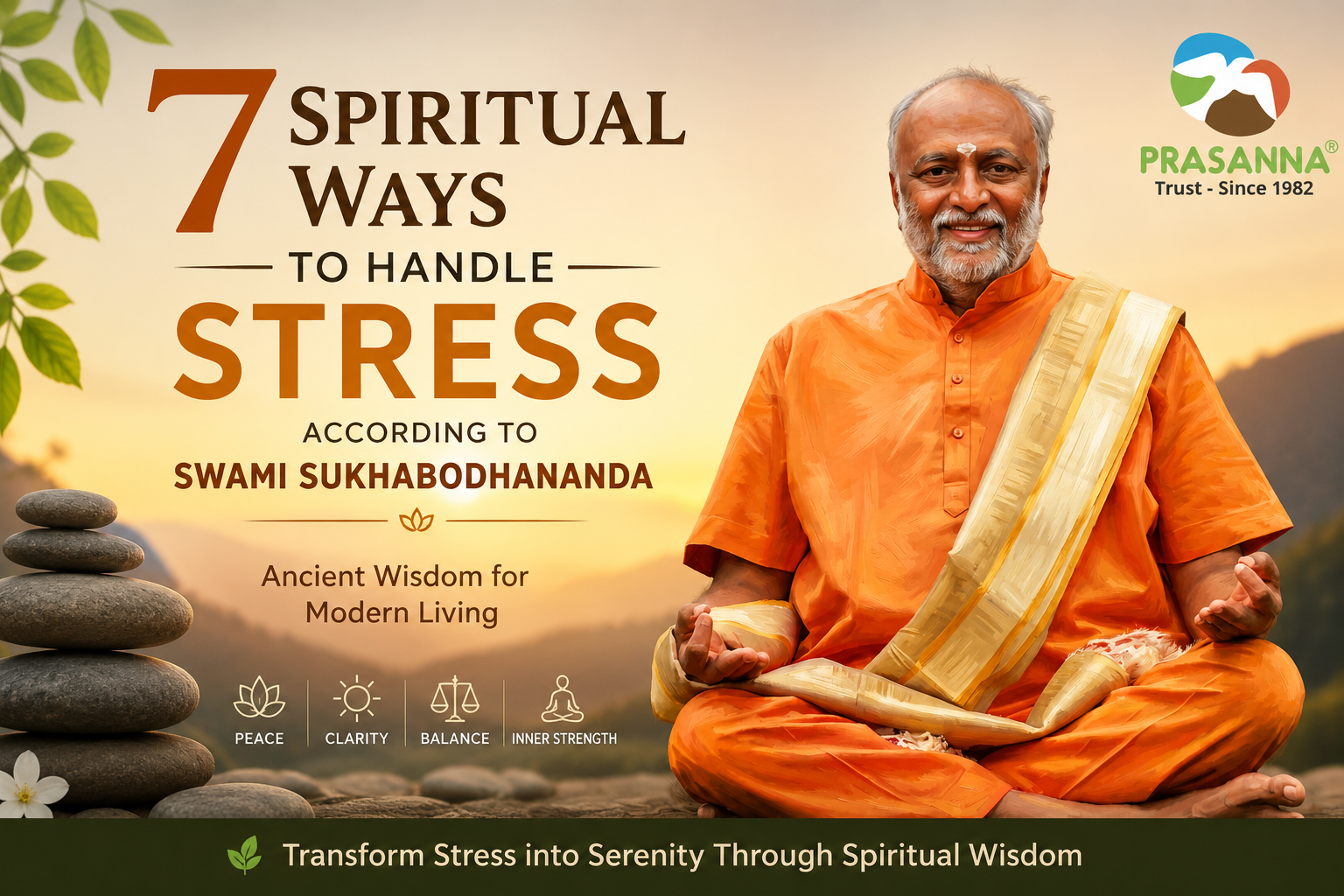
Finding Inner Peace in a Fast-Paced World
In today's world, stress has become an almost constant companion. Whether it arises from work pressures, financial concerns, health challenges, relationships, or the endless stream of information around us, many people find themselves feeling overwhelmed and emotionally exhausted.
While modern solutions often focus on managing external circumstances, spiritual wisdom points us toward a deeper understanding: stress is not merely created by what happens around us but by how we relate to what happens.
Swami Sukhabodhananda, internationally renowned spiritual teacher, author, and founder of Prasanna Trust, has guided millions across the world in discovering practical spiritual tools for inner peace, emotional resilience, and conscious living. His teachings emphasize that peace is not something to be achieved in the future—it is our natural state when the mind is free from unnecessary agitation.
Here are seven profound spiritual practices inspired by Swamiji's teachings that can help transform stress into serenity.
1. Return to the Present Moment
One of the greatest contributors to stress is the mind's tendency to wander.
It revisits the past with regret and projects itself into the future with worry. Yet neither the past nor the future truly exists in this moment. Life unfolds only in the present.
When we remain trapped in memories or anxieties, we miss the richness of the here and now. Swami Sukhabodhananda often reminds seekers that awareness of the present moment is the doorway to freedom.
Consider how often the mind says:
"What if things go wrong?"
"I should have done things differently."
"What will happen tomorrow?"
These thoughts create mental tension without solving the situation.
Practical Exercise
Several times a day, pause and ask yourself:
"Where is my attention right now?"
Take three slow breaths and bring your awareness fully to the present moment.
You may be surprised by how much calm is available when you stop mentally traveling through time.
Why It Works
The present moment is free from psychological stress. Challenges may still exist, but the unnecessary burden created by anticipation and regret begins to dissolve.
2. Observe Your Thoughts Without Identifying With Them
Many people assume that every thought that arises in the mind is true.
However, thoughts are simply mental events. They come and go like clouds passing through the sky.
Stress intensifies when we become completely identified with our thoughts:
"I am going to fail."
"Nobody understands me."
"Everything is going wrong."
When such thoughts are repeated, they begin to shape our emotional state.
Swamiji teaches that awareness is different from thought. You are not your thoughts—you are the observer of your thoughts.
Practical Exercise
Whenever a stressful thought appears, pause and say:
"I am noticing a thought that..."
For example:
"I am noticing a thought that I may fail."
This small shift creates distance between you and the thought.
Why It Works
When thoughts are observed rather than believed automatically, their emotional grip weakens. The mind becomes calmer and more objective.
3. Practice Acceptance Instead of Resistance
Much of our stress comes from resisting reality.
We want situations to be different.
We want people to behave differently.
We want life to unfold according to our plans.
But reality does not always cooperate.
Acceptance is not passive resignation. It is the willingness to see things clearly before responding intelligently.
When we stop arguing with reality, enormous amounts of mental energy become available for constructive action.
Practical Exercise
Draw two columns:
What I Can Control What I Cannot Control
My attitude Other people's opinions
My effort Past events
My choices Uncertain future outcomes
Direct your energy toward the first column.
Why It Works
Acceptance reduces emotional friction and helps us focus on solutions instead of struggles.
4. Cultivate an Attitude of Gratitude
The human mind is naturally programmed to notice problems.
Even when many things are going well, attention often gravitates toward what is missing.
Gratitude changes this pattern.
According to spiritual wisdom, gratitude is one of the fastest ways to shift from scarcity to abundance.
When we consciously acknowledge life's blessings, our perspective changes.
We begin to recognize:
The people who support us.
The opportunities we have received.
The lessons hidden within challenges.
The simple gifts often taken for granted.
Practical Exercise
Before sleeping, write down three things you are grateful for.
They need not be extraordinary.
Examples:
A peaceful meal.
A meaningful conversation.
Good health.
A moment of silence.
Why It Works
Gratitude redirects attention toward what is already working in life, reducing anxiety and fostering emotional well-being.
5. Make Meditation a Daily Practice
Among all spiritual tools, meditation remains one of the most effective methods for managing stress.
Meditation is not about stopping thoughts. It is about developing a new relationship with the mind.
Through regular practice, we learn to rest in awareness rather than becoming lost in mental chatter.
Swami Sukhabodhananda has often emphasized that meditation is not an escape from life—it is preparation for life.
Benefits of Meditation
Regular meditation can help:
Reduce stress and anxiety
Improve focus and concentration
Enhance emotional stability
Increase self-awareness
Improve sleep quality
Foster inner peace
Practical Exercise
Begin with just 10 minutes daily.
Sit comfortably.
Close your eyes.
Observe your breath naturally.
When thoughts arise, gently return your attention to the breath.
Consistency is more important than duration.
Why It Works
Meditation quietens the constant activity of the mind and allows deeper levels of peace to emerge.
6. See Challenges as Opportunities for Growth
Every challenge carries a lesson.
However, stress often causes us to focus only on the problem.
Spiritual wisdom invites us to ask a different question.
Instead of asking:
"Why is this happening to me?"
Ask:
"What is this situation trying to teach me?"
This shift transforms adversity into a path of growth.
Many qualities such as patience, resilience, compassion, and wisdom are developed through challenges rather than comfort.
Practical Exercise
Whenever you face a stressful situation, journal your responses to these questions:
What can I learn from this?
How can this make me stronger?
What quality is life inviting me to develop?
Why It Works
Growth-oriented thinking transforms stress into a catalyst for personal evolution.
7. Surrender and Trust the Flow of Life
One of the deepest spiritual teachings is the art of surrender.
Surrender does not mean giving up responsibility. It means doing your best and then letting go of excessive attachment to results.
Many people experience stress because they constantly try to control outcomes.
But life often unfolds according to a larger intelligence.
When we trust that intelligence, the mind becomes lighter.
Swamiji often teaches that peace comes when effort and trust walk together.
Practical Exercise
At the end of each day, reflect quietly:
"I have done my best today. I trust life to unfold in the right way."
Allow yourself to rest in that trust.
Why It Works
Surrender reduces the burden of carrying every uncertainty on your shoulders.
The Journey from Stress to Serenity
Stress may be a part of modern life, but inner peace remains available to everyone.
By practicing presence, observing thoughts, accepting reality, cultivating gratitude, meditating regularly, learning from challenges, and surrendering with trust, we begin to experience a profound shift in how we relate to life.
The goal is not to eliminate every challenge but to develop the inner strength and wisdom to navigate them gracefully.
As Swami Sukhabodhananda beautifully teaches, peace is not something we need to create—it is already within us, waiting to be discovered beneath the noise of the mind.
Frequently Asked Questions
Can spirituality really help reduce stress?
Yes. Spiritual practices such as meditation, mindfulness, gratitude, and self-awareness help reduce mental agitation and improve emotional resilience.
How much meditation should I practice daily?
Even 10–15 minutes of daily meditation can create noticeable benefits when practiced consistently.
What is the biggest cause of stress according to spiritual teachings?
Many spiritual traditions suggest that stress arises from attachment, resistance, fear, and identification with thoughts.
How can I stay calm during difficult situations?
Focus on what you can control, remain present, and approach challenges as opportunities for learning and growth.
Are Swami Sukhabodhananda's teachings suitable for beginners?
Absolutely. His teachings combine ancient wisdom with practical insights that can be applied in daily life by people from all backgrounds.
Explore More
Discover meditation programs, spiritual retreats, online courses, and transformative teachings by Swami Sukhabodhananda at SwamiSukhabodhananda.com and begin your journey toward greater peace, clarity, and conscious living.